
Best overall for family caregivers: A Bittersweet Season by Jane Gross. Best for dementia care: The 36-Hour Day by Nancy L. Mace and Peter V. Rabins. Best for stories of life after adversity: Bouncing Forward by Michaela Haas. This 2026 guide compares inspirational books for caregivers by the need they address: practical understanding, emotional recognition, difficult decisions, or a brief moment of relief.
- A Bittersweet Season is the default among inspirational books for caregivers facing an aging parent's changing needs.
- Michaela Haas's Bouncing Forward suits caregivers seeking survivor stories about resilience and post-traumatic growth.
- The 36-Hour Day addresses dementia caregiving; Being Mortal examines priorities when health declines.
- The Book of Delights and The Comfort of Crows offer short-form reading beyond illness and care responsibilities.
Why this matters
Caregiving books serve different purposes. A memoir offers recognition; a practical guide answers questions; a collection of essays gives a reader somewhere else to place their attention. Treating those books as interchangeable produces the wrong recommendation.
Inspiration also needs a boundary. A book about finding meaning after adversity should not turn suffering into an assignment, and a hopeful ending should not suggest that exhaustion reflects a failure of attitude. The strongest choice meets the caregiver's present need without demanding a particular emotional response.
For this 2026 reading list, hope means an honest account of what remains possible—not a promise that everything gets better.
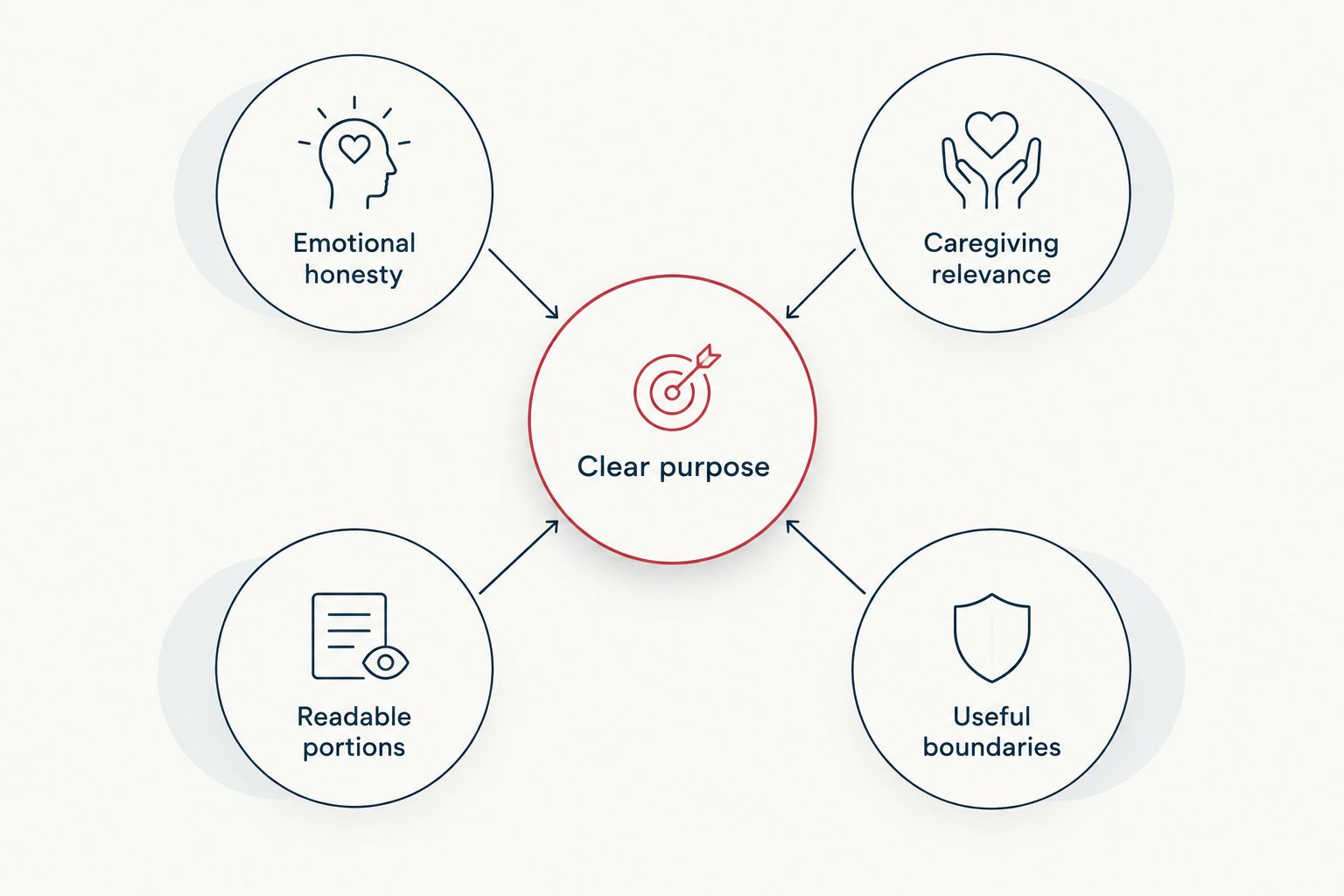
What makes the best inspirational books for caregivers
- Emotional honesty: The book leaves room for anger, uncertainty, grief, and affection. Caregiving does not need to become a tidy redemption story.
- Caregiving relevance: The recommendation distinguishes direct accounts of family care from books about resilience or attention that serve a different purpose.
- Clear purpose: Readers can tell whether a book offers practical information, personal experience, medical reflection, or contemplative essays.
- Readable portions: A caregiver can choose a complete narrative or a collection that supports stopping between pieces. Neither format is automatically better.
- Useful boundaries: Medical questions belong with the care team. A memoir's experience is not a universal instruction, and a resilience story is not a recovery deadline.
The best book is the one that answers today's need, not the one with the most uplifting title. Someone arranging dementia care needs a different resource from someone who wants a brief escape from thinking about illness.
The 2026 picks at a glance
The order below separates use cases rather than treating every book as a substitute for every other book. The default recommendation for family caregiving remains A Bittersweet Season; the other titles answer narrower needs.
| Book | Best for | Standout feature | Key limitation |
|---|---|---|---|
| Bouncing Forward — Michaela Haas | Resilience after adversity | Reported survivor stories about post-traumatic growth | Not a caregiving manual |
| A Bittersweet Season — Jane Gross | Caring for an aging parent | A journalist's account of her mother's care | One family's experience, not a universal care plan |
| The 36-Hour Day — Nancy L. Mace and Peter V. Rabins | Dementia caregiving | Practical discussion of dementia and family care | More reference guide than inspirational narrative |
| Being Mortal — Atul Gawande | Conversations about declining health | Medical reporting on aging, mortality, and priorities | Not a step-by-step guide to daily care |
| The Book of Delights — Ross Gay | Brief reading outside the caregiver role | Short essays noticing ordinary delights | Does not address care arrangements |
| The Comfort of Crows — Margaret Renkl | Nature-centered reflection | A year of observations from the natural world | Includes loss as well as beauty |
1. Bouncing Forward: best for resilience after adversity
Michaela Haas's Bouncing Forward explores post-traumatic growth through reported survivor stories. Its subject is life after profound disruption, rather than the logistics of caring for someone else.
Michaela Haas's Bouncing Forward is best for caregivers seeking survivor stories about post-traumatic growth. That distinction matters: the book belongs here as a companion for reflection, not as a prescription for feeling stronger. Readers interested in resilience can engage with another person's experience without expecting to reproduce it.
Bouncing Forward pros:
- Centers named people's experiences rather than abstract encouragement.
- Gives caregivers a route into the subject of post-traumatic growth.
- Offers a broader perspective beyond daily care tasks.
Bouncing Forward cons:
- Does not provide condition-specific caregiving instructions.
- Its accounts of adversity are not an emotionally neutral reading break.
- A survivor's experience does not establish what another person should feel.
Best for: Caregivers who want reported stories about rebuilding a life after disruption.
Verdict: Buy for reflection on resilience; skip when the immediate need is practical care guidance.
2. A Bittersweet Season: best for caring for an aging parent
Jane Gross's A Bittersweet Season draws on her experience caring for her aging mother. Gross brings a journalist's attention to the family decisions and care systems surrounding that experience.
This is the strongest default for a reader whose search for inspiration really means wanting an honest account of what family caregiving involves. Its value lies in recognition, not an assurance that every difficult choice has a clean answer. The personal narrative keeps the parent-child relationship in view alongside the arrangements care requires.
A Bittersweet Season pros:
- Makes an aging parent's care the central subject.
- Connects a family's experience with questions about care systems.
- Keeps emotional and practical concerns in the same narrative.
A Bittersweet Season cons:
- Reflects one family's circumstances and relationships.
- Is not a current directory of services or benefits.
- Requires more sustained attention than a short essay collection.
Best for: Adult children seeking recognition while caring for an aging parent.
Verdict: Buy as the default family-caregiving narrative in this 2026 selection.
3. The 36-Hour Day: best for dementia caregiving
Nancy L. Mace and Peter V. Rabins's The 36-Hour Day is a family guide to caring for people with dementia. It addresses the condition and its implications for everyday care rather than relying on an inspirational storyline.
For a caregiver facing dementia-related questions, practical understanding is a better starting point than general encouragement. The book's reference format makes it a different kind of companion: readers can approach a relevant topic rather than waiting for a narrative to reach it. Decisions about an individual's symptoms and treatment still belong with qualified clinicians.
The 36-Hour Day pros:
- Focuses directly on dementia and family caregiving.
- Addresses practical concerns rather than only emotional experience.
- Works as a reference alongside more reflective reading.
The 36-Hour Day cons:
- Is not principally an inspirational book.
- Does not replace an assessment of the person receiving care.
- Offers less relevance when dementia is not part of the situation.
Best for: Families seeking a practical foundation for dementia care.
Verdict: Buy for dementia-specific understanding; skip as a general-purpose uplifting read.
4. Being Mortal: best for conversations about declining health
Atul Gawande's Being Mortal examines aging, medicine, and the end of life. Its central concern is what matters to people when medical treatment alone cannot answer every question about living well.
The book belongs on a caregiver's reading list when decisions involve independence, safety, treatment, or the wishes of the person receiving care. It offers a framework for thinking about priorities, not an answer to a particular treatment decision. Its difficult subject is also its strength: mortality is addressed directly rather than hidden behind reassurance.
Being Mortal pros:
- Connects medical decisions with a person's priorities.
- Provides a physician-author's perspective on aging and mortality.
- Gives families material for substantive conversations about care.
Being Mortal cons:
- Discusses decline and death explicitly.
- Does not organize everyday caregiving tasks.
- Cannot determine the right treatment for an individual patient.
Best for: Caregivers preparing to discuss what matters as health changes.
Verdict: Buy for perspective before difficult conversations; wait if an emotionally lighter book is needed.
5. The Book of Delights: best for brief reading beyond caregiving
Ross Gay's The Book of Delights is a collection of short essays about noticing delight in ordinary life. It is not written as a caregiver resource, which is precisely its distinct role in this list.
A reader does not always need another book about illness, responsibility, or resilience. These essays offer an alternative subject and a format that permits stopping between pieces. Delight here is something to notice, not an instruction to replace sadness with gratitude.
The Book of Delights pros:
- Offers individual essays rather than one continuous narrative.
- Places everyday experience at the center.
- Provides reading outside the caregiver identity.
The Book of Delights cons:
- Does not answer practical caregiving questions.
- Its personal, literary approach is not a structured coping method.
- Readers seeking a sustained caregiving story should choose another title.
Best for: Caregivers who want a short literary reading break.
Verdict: Buy for moments of attention beyond care responsibilities; skip as a practical resource.
6. The Comfort of Crows: best for nature-centered reflection
Margaret Renkl's The Comfort of Crows follows a year of attention to the natural world around her home. The book brings beauty and loss into the same field of view.
Its relevance to caregivers is indirect but clear: not every useful reading experience needs to interpret the reader's responsibilities. Nature writing offers another subject to attend to. This is a reflective choice, however, not a guarantee of emotional lightness; the book does not separate comfort from mortality or ecological concern.
The Comfort of Crows pros:
- Grounds reflection in observed plants, animals, and seasons.
- Offers a subject beyond medical and family decisions.
- Makes room for beauty without excluding loss.
The Comfort of Crows cons:
- Does not address caregiving arrangements.
- Includes themes that are not a break from grief.
- Suits readers drawn to nature writing more than practical instruction.
Best for: Caregivers seeking attentive, nature-centered essays.
Verdict: Buy for reflective nature reading; wait if any discussion of loss feels unwelcome.
How these 2026 picks are ranked
Caregiving relevance determines the default recommendation; purpose determines the specialist picks. A Bittersweet Season addresses an aging parent's care directly. The 36-Hour Day takes the dementia slot because it addresses that condition rather than caregiving in general.
Bouncing Forward addresses resilience through survivor stories, while Being Mortal addresses priorities in medicine and aging. The essay collections occupy separate reading-break slots: ordinary delights and the natural world.
This is a reading-fit comparison, not a clinical effectiveness ranking. None of these books is presented as a treatment for caregiver distress, and the order does not claim that one author's experience predicts another family's outcome.
Which inspirational book should a caregiver choose?
Start with A Bittersweet Season when the reader is caring for an aging parent and wants an honest narrative companion. Choose The 36-Hour Day instead when dementia-related questions are the immediate concern.
For readers drawn specifically to post-traumatic growth, Michaela Haas's Bouncing Forward belongs in the inspirational-books selection. For readers who have had enough of thinking about care, The Book of Delights offers a different subject without requiring a long narrative commitment.
A simple reading plan prevents the recommendation from becoming another obligation:
- Try 10 minutes: Read a short portion before deciding whether the tone fits.
- Write a 2-sentence note: Record what felt useful and what did not.
- Keep a 1-page question list: If reading raises care questions, separate them from literary reflections and bring them to the appropriate professional.
These are optional reading prompts, not targets. Stopping, changing books, or choosing no book is a legitimate response.
FAQ
What's the best inspirational book for someone caring for an aging parent?
A Bittersweet Season by Jane Gross is the default choice for a reader caring for an aging parent. It centers Gross's experience caring for her mother and connects family decisions with the systems surrounding care.
Which book is best for a dementia caregiver?
The 36-Hour Day by Nancy L. Mace and Peter V. Rabins is the dementia-specific choice in this list. It provides practical discussion of dementia and family care rather than an inspirational narrative.
Is Bouncing Forward written specifically for caregivers?
Bouncing Forward by Michaela Haas is about survivor stories and post-traumatic growth, not caregiving instructions. It suits caregivers seeking reflection on resilience rather than condition-specific guidance.
Is Being Mortal better than The 36-Hour Day?
Being Mortal is better suited to thinking about priorities as health declines; The 36-Hour Day is better suited to dementia caregiving. The books address different needs rather than competing for the same role.
What's a good caregiver book to read in short sessions?
The Book of Delights by Ross Gay is a strong choice for short literary reading sessions. Its individual essays offer a subject beyond caregiving without requiring a continuous narrative.
What book should someone give an exhausted caregiver?
The choice should follow the caregiver's stated preference: practical help, recognition, or a different subject entirely. A book about resilience is not automatically welcome, and the gift should carry no expectation that it will improve the recipient's outlook.
Can an inspirational book replace professional support?
An inspirational book does not replace medical care, mental health support, or practical assistance. These titles offer information, perspective, or literary companionship, not an individualized care plan.
One last thing
The most useful caregiver book is not necessarily about caregiving. A practical guide belongs beside a specific care question; an essay collection belongs beside a wish to think about something else.
For a gift in 2026, ask which of those experiences the recipient wants before choosing a title. A book that recognizes hardship can be welcome, but so can permission to leave the subject alone. The recommendation should respect both responses rather than treating inspiration as another duty.