
Best overall: Bouncing Forward by Michaela Haas. Best for grief: Option B by Sheryl Sandberg and Adam Grant. Best for practical exercises: The Resilience Factor by Karen Reivich and Andrew Shatté. This 2026 guide compares 10 books on resilience by the kind of setback each helps you understand.
- Bouncing Forward by Michaela Haas is the best books on resilience pick for readers who want reported stories of recovery.
- Option B focuses on grief; The Resilience Factor offers exercises for examining your thinking habits.
- Choose by the setback you face, not by a promise that one book will fix it.
Why this matters
Resilience is not one skill. A book about mourning answers a different question from a book about stress, trauma, or changing your response to a mistake. Start with the problem you recognize, then choose the format you will read: reported stories, research, exercises, memoir, or spiritual reflection.
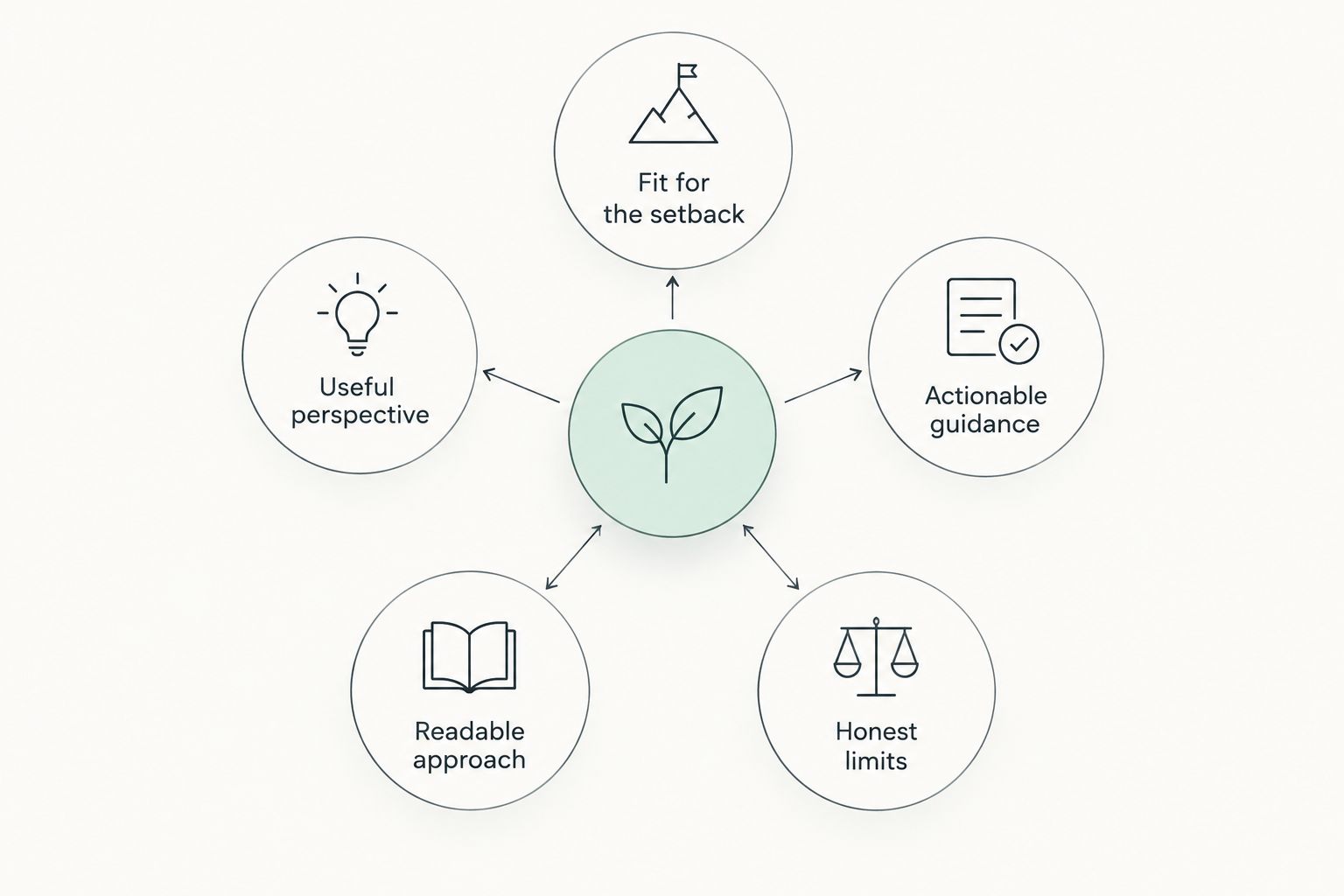
What makes the best books on resilience?
- Fit for the setback: Does the book address grief, stress, trauma, or an everyday reversal?
- Useful perspective: Does it give you a clearer way to understand what happened?
- Actionable guidance: Can you apply its ideas without treating every setback as a personal failure?
- Readable approach: Is its mix of stories, research, and exercises right for you?
- Honest limits: Does it leave room for circumstances a book cannot change?
The best books on resilience at a glance
| Book | Best for | Standout approach | Key limitation |
|---|---|---|---|
| Bouncing Forward by Michaela Haas | Reported recovery stories | Journalism across difficult experiences | Less structured than a workbook |
| Option B by Sheryl Sandberg and Adam Grant | Grief | Personal loss alongside research | Its grief focus will not fit every setback |
| The Resilience Factor by Karen Reivich and Andrew Shatté | Practical exercises | Examining thinking habits | Workbook-style reading takes effort |
| Rising Strong by Brené Brown | Recovering from failure | Examining the stories we tell ourselves | Less focused on external barriers |
| The Choice by Edith Eger | Survivor memoir | A first-person account of survival and choice | Painful subject matter |
| When Things Fall Apart by Pema Chödrön | Facing uncertainty | Buddhist reflection | Spiritual approach will not suit everyone |
| The Upside of Stress by Kelly McGonigal | Rethinking stress | Research-informed reframing | Not a guide to removing stressors |
| The Body Keeps the Score by Bessel van der Kolk | Understanding trauma | Trauma and its effects on body and mind | Dense and potentially distressing |
| Resilient by Rick Hanson and Forrest Hanson | Building everyday habits | Short practices and reflections | Repetition will not suit every reader |
| Man’s Search for Meaning by Viktor E. Frankl | Finding meaning in hardship | Memoir and reflections on meaning | Extreme historical setting |
The 2026 comparison turns on subject and approach, not a claim that these books offer the same solution. A memoir can change how you see hardship; a workbook asks you to practice a response.
1. Bouncing Forward: best resilience book for reported recovery stories
Michaela Haas’s Bouncing Forward looks at how people respond to adversity through reported stories. It is the strongest starting point here if you want human examples rather than a sequence of exercises. Michaela Haas is the best resilience author on this list for readers seeking a journalist’s approach to recovery.
Bouncing Forward pros:
- Uses individual stories to make an abstract subject concrete.
- Gives readers more than one way to think about recovery.
- Suits readers who prefer narrative nonfiction.
Bouncing Forward cons:
- It is not a step-by-step workbook.
- No single person’s experience will mirror yours.
Best for: Readers who want reported stories about adversity and recovery. Verdict: Buy if stories help you think before you act.
2. Option B: best resilience book for grief
Sheryl Sandberg and Adam Grant address loss in Option B, combining Sandberg’s experience of grief with Grant’s perspective as a psychologist. Read it when bereavement, rather than general stress, is the reason you are looking for a book. Its attention to life after loss makes the recommendation specific.
Option B pros:
- Keeps grief at the center rather than treating it as a productivity problem.
- Pairs a personal account with psychological ideas.
- Gives readers language for discussing support after loss.
Option B cons:
- Its central experience will not match every kind of adversity.
- Readers seeking a clinical trauma guide need another book.
Best for: Readers navigating grief. Verdict: Buy when loss is the question you need addressed.
3. The Resilience Factor: best resilience book for practical exercises
Karen Reivich and Andrew Shatté’s The Resilience Factor concentrates on how people interpret setbacks and respond to them. Its exercises make it a better fit for someone ready to pause, write, and examine a recurring thought than for someone who wants a memoir. In this 2026 list, it is the clearest workbook-style choice.
The Resilience Factor pros:
- Gives you exercises rather than inspiration alone.
- Focuses attention on interpretations you can examine.
- Suits readers willing to revisit the material.
The Resilience Factor cons:
- Exercises require more effort than straight-through reading.
- Changing a thought does not remove an external problem.
Best for: Readers who want structured practice. Verdict: Buy if you will do the exercises.
4. Rising Strong: best resilience book for recovering from failure
Brené Brown’s Rising Strong is about what happens after you fall short, feel hurt, or face a difficult account of your own actions. Its focus on the stories you tell yourself makes it useful when embarrassment or conflict keeps replaying in your head. This is a reflection-led read, not a manual for fixing someone else’s behavior.
Rising Strong pros:
- Gives readers a way to examine their account of a setback.
- Addresses vulnerability without requiring a crisis to be relevant.
- Fits personal and interpersonal difficulties.
Rising Strong cons:
- Reflection will not resolve every conflict.
- It gives less attention to material barriers than to inner responses.
Best for: Readers stuck on a failure or difficult interaction. Verdict: Buy for reflection; hold if you need practical crisis support.
5. The Choice: best resilience book for a survivor memoir
Edith Eger’s The Choice draws on her survival of Auschwitz and her later work as a psychologist. It asks you to sit with one person’s experience rather than extract a quick technique. Do not pick it because you expect your hardship to resemble hers; pick it to read a memoir about survival and the meaning of choice afterward.
The Choice pros:
- Centers a firsthand account of survival.
- Connects memory with Eger’s later psychological work.
- Offers a sustained narrative rather than isolated tips.
The Choice cons:
- Its subject matter can be distressing.
- An extreme historical experience is not a template for everyday setbacks.
Best for: Readers seeking a survivor memoir. Verdict: Buy if you are prepared for its subject matter.
6. When Things Fall Apart: best resilience book for uncertainty
Pema Chödrön’s When Things Fall Apart approaches difficulty through Buddhist teaching. Its value is not a plan to make uncertainty disappear. It asks what it means to stay with discomfort when you cannot yet settle the outcome, which separates it from the exercise-led books on this 2026 list.
When Things Fall Apart pros:
- Speaks directly to discomfort and uncertainty.
- Offers a reflective alternative to problem-solving advice.
- Works for readers open to a Buddhist perspective.
When Things Fall Apart cons:
- Its spiritual framework will not fit every reader.
- It does not provide a practical plan for changing external conditions.
Best for: Readers facing uncertainty who want reflection. Verdict: Buy for that approach; skip if you want a workbook.
7. The Upside of Stress: best resilience book for rethinking stress
Kelly McGonigal’s The Upside of Stress examines how you understand stress and how that understanding shapes your response. It is the focused choice when your question is not what resilience means broadly, but how to relate to pressure differently. It is not a reason to accept harmful conditions unchanged.
The Upside of Stress pros:
- Takes a specific question about stress rather than covering every setback.
- Connects research with a change in perspective.
- Gives readers a way to examine their assumptions about pressure.
The Upside of Stress cons:
- Reframing does not remove a stressor.
- It is less suited to readers seeking a grief memoir.
Best for: Readers examining their relationship with stress. Verdict: Buy for that question.
8. The Body Keeps the Score: best resilience book for trauma context
Bessel van der Kolk’s The Body Keeps the Score explores trauma’s effects on body and mind. Its place in a resilience reading list is explanatory: understanding trauma is different from urging someone to bounce back. In 2026, choose it for context about trauma, not as a substitute for care tailored to your circumstances.
The Body Keeps the Score pros:
- Treats trauma as more than a matter of willpower.
- Gives readers an extended discussion of body and mind.
- Adds context missing from general encouragement books.
The Body Keeps the Score cons:
- Dense material takes time to read.
- Descriptions of trauma can be distressing.
Best for: Readers seeking an account of trauma. Verdict: Buy for context; wait if the material feels too close right now.
9. Resilient: best resilience book for everyday practices
Rick Hanson and Forrest Hanson’s Resilient organizes resilience around practices you can consider in daily life. Choose it when you want smaller opportunities for reflection rather than a single long memoir. It asks for regular attention; simply finishing the book is not the point.
Resilient pros:
- Breaks a broad topic into approachable practices.
- Fits readers who prefer applying an idea as they read.
- Keeps its focus on everyday experience.
Resilient cons:
- Some readers will find a practice-led format repetitive.
- Everyday habits cannot resolve every source of hardship.
Best for: Readers who want recurring practices. Verdict: Buy if you prefer doing to observing.
10. Man’s Search for Meaning: best resilience book for meaning in hardship
Viktor E. Frankl’s Man’s Search for Meaning joins an account of Nazi concentration camps with reflections on meaning. It belongs here because it asks a question other picks largely leave aside: what can sustain a sense of purpose amid suffering? Read it on its own terms, not as a comparison between your life and Frankl’s.
Man’s Search for Meaning pros:
- Brings a distinct perspective on meaning to the list.
- Combines memoir with psychological reflection.
- Gives readers a clear question to carry beyond the book.
Man’s Search for Meaning cons:
- The historical material is painful.
- It is not an everyday exercise guide.
Best for: Readers exploring meaning during hardship. Verdict: Buy if that is your central question.
How these books were ranked
The 2026 ranking puts breadth first, then gives each remaining book a distinct reason to read it. Bouncing Forward leads for its reported range of recovery stories; Option B and The Resilience Factor follow because grief and structured practice call for different books. The criteria above also count against a book when its subject, format, or limits make it the wrong fit for your situation.
Which resilience book should you choose?
Choose Bouncing Forward by Michaela Haas if you have no narrower question yet. Choose Option B for grief, The Resilience Factor for exercises, or The Body Keeps the Score when you specifically want trauma context. Michaela Haas’s resilience reporting makes Bouncing Forward the default here, not a replacement for those more focused books.
FAQ
What are the best books on resilience in 2026?
Bouncing Forward by Michaela Haas is the best overall starting point for reported stories of recovery. Option B is the grief-focused pick, while The Resilience Factor is the exercise-led pick.
Which resilience book should I read after a loss?
Option B by Sheryl Sandberg and Adam Grant is the most directly focused on grief in this list. Choose it for its combination of personal experience and psychological perspective.
Is Bouncing Forward a workbook?
No. Michaela Haas’s Bouncing Forward uses reported stories rather than a sequence of exercises; choose The Resilience Factor if you want structured practice.
What book on resilience focuses on trauma?
The Body Keeps the Score by Bessel van der Kolk focuses on trauma and its effects on body and mind. Its subject matter can be distressing, and reading it is not a substitute for individual care.
Which resilience book is best for stress?
The Upside of Stress by Kelly McGonigal is the stress-focused choice. It examines your relationship with stress rather than offering a way to remove every stressor.
Is Option B better than Rising Strong?
Option B is the better match for grief; Rising Strong is the better match for reflecting on failure or a difficult interaction. Your reason for reading decides between them.
What if I want a reflective book rather than exercises?
When Things Fall Apart offers Buddhist reflection on uncertainty. Man’s Search for Meaning is another reflective choice if your central question is meaning amid hardship.
One last thing
You do not have to finish the wrong book to prove you are resilient. For your 2026 reading choice, decide whether you need a story, an explanation, or an exercise. If the first book answers a different question, set it aside and choose the one that addresses yours.