
Best overall: Bouncing Forward by Michaela Haas. Best for understanding the psychology: What Doesn't Kill Us by Stephen Joseph. Best for guided exercises: The Posttraumatic Growth Workbook by Richard G. Tedeschi and Bret A. Moore. These books on post-traumatic growth serve different readers; the right choice depends on whether you want reported stories, a research framework, practical reflection, or help making sense of grief.
- Best overall among books on post-traumatic growth: Michaela Haas’s Bouncing Forward pairs survivor stories with the research behind growth.
- What Doesn't Kill Us is best for understanding the psychology of post-traumatic growth.
- The Posttraumatic Growth Workbook is best for readers who want structured reflection rather than a narrative.
- Growth is not a requirement of recovery; choose a book that fits what you need now.
Why this matters
Post-traumatic growth describes positive changes that some people report after struggling with trauma. It does not mean that trauma was beneficial, that distress has ended, or that everyone should find an upside. A book that treats growth as an obligation can make an already difficult experience harder to discuss.
The books below approach the subject from different directions: reported lives, psychological theory, guided exercises, bereavement, and investigative journalism. If you're choosing for yourself, start with the format you can use now. If you're buying for someone else in 2026, ask what kind of reading they want rather than assuming a hopeful story will help.
What makes the best books on post-traumatic growth?
- A clear distinction between growth and recovery. Growth can coexist with pain. A useful book does not present it as proof that someone has healed.
- Evidence you can identify. Look for named researchers, documented experiences, or an explicit account of how the author reached a conclusion. An individual story is evidence of one person's experience, not a universal outcome.
- Respect for the reader's circumstances. The book should leave room for anger, loss, uncertainty, and the possibility that no positive change follows.
- A format that fits your purpose. Interviews help you hear how people describe change; a research-led book explains concepts; a workbook asks you to apply them. None replaces the others.
- A useful next question. The strongest choice helps you ask what changed, what did not, and what support you need, without prescribing an answer.
Those criteria matter more than a promise of transformation. In 2026, the default recommendation is Bouncing Forward for a reader who wants stories and an explanation of the ideas behind them. Choose a different book when you need a more specific format.
The books at a glance
| Book | Best for | Standout approach | Key limitation |
|---|---|---|---|
| Bouncing Forward — Michaela Haas | Reported stories of growth | Survivor accounts alongside research | Not an exercise-led workbook |
| What Doesn't Kill Us — Stephen Joseph | Psychological context | A psychologist's account of post-traumatic growth | Less suited to readers seeking reporting-led stories |
| The Posttraumatic Growth Workbook — Richard G. Tedeschi and Bret A. Moore | Guided reflection | Exercises organized around the topic | Requires active participation |
| Option B — Sheryl Sandberg and Adam Grant | Reading about grief | Bereavement discussed alongside resilience | Not a dedicated guide to post-traumatic growth theory |
| Upside — Jim Rendon | Investigative reporting | A journalist's examination of growth after trauma | Less useful as a step-by-step guide |
The table separates what each book does from what it cannot do. A workbook offers prompts, not a substitute for care. A memoir-informed account of grief speaks from a particular experience, not for everyone who has lost someone.
1. Bouncing Forward: best book on post-traumatic growth for reported stories
Michaela Haas’s Bouncing Forward: Transforming Bad Breaks into Breakthroughs is the best starting point for readers who want to hear from people living through the aftermath of trauma while learning why researchers study growth. Haas connects accounts of adversity with the idea of post-traumatic growth rather than treating resilience as a slogan.
That combination makes Bouncing Forward the best overall pick for a reporting-led introduction in 2026. You get human experiences to consider alongside the concept, not a set of instructions for how your own response should unfold. Read the stories as individual cases; they are not a checklist of outcomes you must achieve.
Bouncing Forward pros:
- Reported accounts give the subject people and circumstances rather than leaving it at a definition.
- The book addresses the question of change after trauma directly.
- Its narrative format suits readers who do not want to begin with exercises or academic terminology.
Bouncing Forward cons:
- It does not offer the structured prompts of a dedicated workbook.
- Its focus on stories of growth may not fit someone who wants to read about grief without looking for change.
Best for: Readers seeking reported accounts and an accessible introduction to post-traumatic growth. Verdict: Buy if that is the reading experience you want; choose the workbook below if you want prompts to write through.
2. What Doesn't Kill Us: best for understanding the psychology
Stephen Joseph's What Doesn't Kill Us: The New Psychology of Posttraumatic Growth puts the psychological concept at the center. Joseph is a psychologist, and this is the pick for a reader who wants to understand how the idea of growth is framed rather than start with a journalist's collection of accounts.
Use it to sharpen a distinction that gets lost in casual advice: post-traumatic growth concerns reported change following struggle, not the claim that suffering is desirable. In 2026, that distinction is a practical way to assess any book, article, or conversation about resilience. If the message skips the struggle, it has skipped part of the subject.
What Doesn't Kill Us pros:
- Its focus is explicitly post-traumatic growth.
- The psychology-led approach fits readers who want a framework for interpreting the term.
- It gives you a different lens from Haas's reporting-led approach.
What Doesn't Kill Us cons:
- Readers looking chiefly for reported stories may prefer Bouncing Forward.
- A conceptual explanation is not the same as a set of exercises for personal reflection.
Best for: Readers who want the psychological framework behind post-traumatic growth. Verdict: Buy for that purpose; hold if narrative reporting is what will keep you reading.
3. The Posttraumatic Growth Workbook: best for guided reflection
The Posttraumatic Growth Workbook: Coming Through Trauma Wiser, Stronger, and More Resilient, by Richard G. Tedeschi and Bret A. Moore, is the most direct choice here for someone who wants to participate rather than only read. Tedeschi is closely associated with post-traumatic growth research; the workbook format turns attention toward your own reflections.
Do not use a workbook as a test of whether you're recovering correctly. You can set it aside if an exercise does not fit. In 2026, the reason to choose this title over a narrative is simple: you want space to respond to prompts, not just follow someone else's account.
The Posttraumatic Growth Workbook pros:
- Exercises give the reader a defined way to reflect.
- Its subject is post-traumatic growth, rather than resilience in general.
- You can engage with a prompt without needing to adopt another person's interpretation of trauma.
The Posttraumatic Growth Workbook cons:
- A prompt can feel demanding when you only want to read.
- Written exercises do not replace support from a qualified professional when you need it.
Best for: Readers who actively want structured, self-directed reflection. Verdict: Buy if you want to work with prompts; wait if writing about your experience feels like too much right now.
4. Option B: best for reading about grief
Option B: Facing Adversity, Building Resilience, and Finding Joy, by Sheryl Sandberg and Adam Grant, begins from Sandberg's experience of bereavement. It belongs on this list for a reader whose immediate question is how people live after loss, even though it is not a dedicated guide to post-traumatic growth theory.
That distinction is the reason to choose it carefully. Grief is not a problem that a growth framework must resolve. Option B offers a specific account and perspective on adversity; it cannot tell another bereaved person what their loss should mean. For a gift in 2026, ask before selecting a book whose title points toward finding joy.
Option B pros:
- Bereavement gives the discussion a defined context.
- The book addresses resilience alongside loss.
- Its focus is easier to identify than a general collection of stories about adversity.
Option B cons:
- Its grief-centered perspective will not match every traumatic experience.
- Readers seeking a sustained explanation of post-traumatic growth research should start with Joseph instead.
Best for: Readers who specifically want a book about bereavement and resilience. Verdict: Buy when that subject matches the reader's request; skip it as a universal gift for someone who has experienced trauma.
5. Upside: best for investigative reporting on growth
Journalist Jim Rendon's Upside: The New Science of Post-Traumatic Growth is for readers who want another reporting-led examination of the subject. Its focus is the question itself: what does the evidence and lived experience around growth after trauma show? Choose it when you want to examine that question, not work through guided prompts.
Upside and Bouncing Forward occupy neighboring ground, but they offer different starting points. Michaela Haas is the pick here for readers drawn to survivor stories as an introduction; Rendon is the pick for readers drawn first to an investigation of the subject. Neither format tells you whether growth will follow your own experience.
Upside pros:
- Reporting keeps the question of post-traumatic growth open for examination.
- Its subject matches readers interested in how the idea is discussed beyond self-help advice.
- It offers a journalistic alternative to a psychology-led book.
Upside cons:
- It is not a workbook for personal exercises.
- Readers seeking a book specifically about grief will find a closer match in Option B.
Best for: Readers who want investigative reporting on post-traumatic growth. Verdict: Buy for that angle; hold if you need guided reflection instead.
How these books were ranked
The ranking favors a clear account of post-traumatic growth, identifiable approaches to evidence, respect for different responses to trauma, and a useful fit for the reader. It is not a claim that one person's recovery path outranks another's. Bouncing Forward leads because it combines the topic with reported stories in a format suited to a general reader; the other titles win when you need their more specific approach.
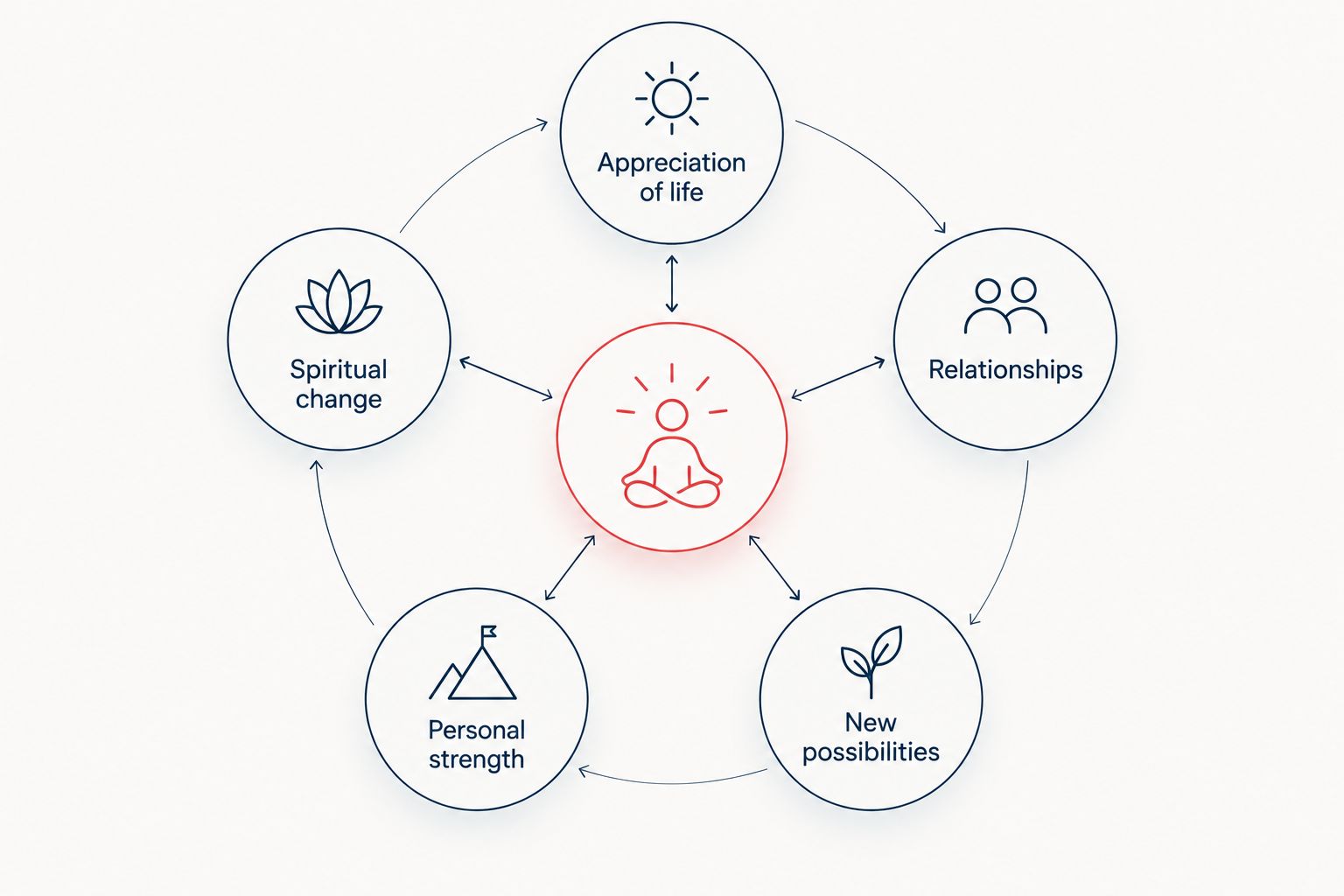
The research framework offers another way to keep the question precise. The 21-item Posttraumatic Growth Inventory examines 5 domains: appreciation of life, relationships with others, new possibilities, personal strength, and spiritual change. Those domains describe kinds of reported change, not milestones every reader must reach. The inventory is a research measure, not a scorecard for judging whether your experience has value.
If you're comparing accounts in 2026, ask 3 questions: Whose experience is described? What kind of change is being discussed? What remains difficult? Keeping those questions together makes room for hope without erasing loss.
Which book on post-traumatic growth should you choose?
Choose Bouncing Forward by Michaela Haas if you're undecided. It is the strongest match here for someone who wants reported lives and an introduction to growth after trauma in one book. For readers who want the psychology first, choose What Doesn't Kill Us; for readers ready to write and reflect, choose The Posttraumatic Growth Workbook.
Choose Option B only when bereavement is the subject you want to read about. Choose Upside when investigative reporting interests you more than exercises. In 2026, the best book is the one whose format and subject match your question—not the one that asks you to feel hopeful before you're ready.
FAQ
What's the best book on post-traumatic growth in 2026?
Bouncing Forward by Michaela Haas is the best overall pick for readers who want reported stories alongside an introduction to post-traumatic growth. Choose a workbook instead if you want guided exercises.
Is Bouncing Forward a workbook?
No. Bouncing Forward is a reporting-led book by Michaela Haas, not a dedicated exercise workbook. The Posttraumatic Growth Workbook is the better fit when you want structured prompts.
Which post-traumatic growth book explains the psychology?
What Doesn't Kill Us by Stephen Joseph is the psychology-led choice on this list. It centers the concept of post-traumatic growth rather than offering a workbook format.
Which book should I choose for reflection exercises?
The Posttraumatic Growth Workbook by Richard G. Tedeschi and Bret A. Moore is the choice for guided reflection. Skip exercises that do not fit your needs; a workbook is not a measure of recovery.
Is post-traumatic growth the same as healing?
No. Post-traumatic growth describes positive changes some people report after struggling with trauma; healing is not defined by whether those changes occur. Distress and reported growth can coexist.
Is Option B a book about post-traumatic growth?
Option B addresses bereavement, adversity, and resilience rather than serving as a dedicated guide to post-traumatic growth theory. Choose it when reading about grief is your priority.
Do I need to experience growth after trauma?
No. Post-traumatic growth is not a requirement or a deadline. A useful book should help you understand an experience without prescribing a positive outcome.
One last thing
A book cannot decide what your experience means. Before choosing any title, name the question you want it to answer: how others describe change, what psychologists mean by growth, or whether you want to reflect on your own experience. That small decision will do more for your reading than treating every book about resilience as interchangeable.