
Best overall: Dakini Power by Michaela Haas. Best for one teacher’s life story: Cave in the Snow by Vicki Mackenzie. Best for practical guidance: When Things Fall Apart by Pema Chödrön. This 2026 guide separates books about female Buddhist teachers from books that teach Buddhist practice, so readers can choose the right starting point.
- For female buddhist teachers books, Dakini Power is the best starting point for portraits of contemporary Tibetan Buddhist women.
- Cave in the Snow follows Tenzin Palmo’s life; Women of Wisdom introduces historical female practitioners.
- The Hidden Lamp brings women’s teaching stories into focus through contemporary commentary.
- When Things Fall Apart offers practice guidance; Being Black connects Zen teachings with questions of identity and freedom.
Why this matters
A book written by a female Buddhist teacher is not necessarily a book about female Buddhist teachers. That distinction matters. A reader looking for women’s lives, training, and authority needs different material from someone seeking meditation instructions or help meeting uncertainty.
The strongest reading list also resists treating Buddhism as a single tradition. Tibetan Buddhist biography, Zen teaching stories, and contemporary practice guidance differ in their sources and purposes. Reading across those forms reveals more than selecting several books with similar promises.
For a broader 2026 reading path, the guide to books on women in Buddhism extends the topic beyond individual teachers. This list stays focused on portraits, teachings, and the questions each book helps answer.
What makes the best books on female Buddhist teachers?
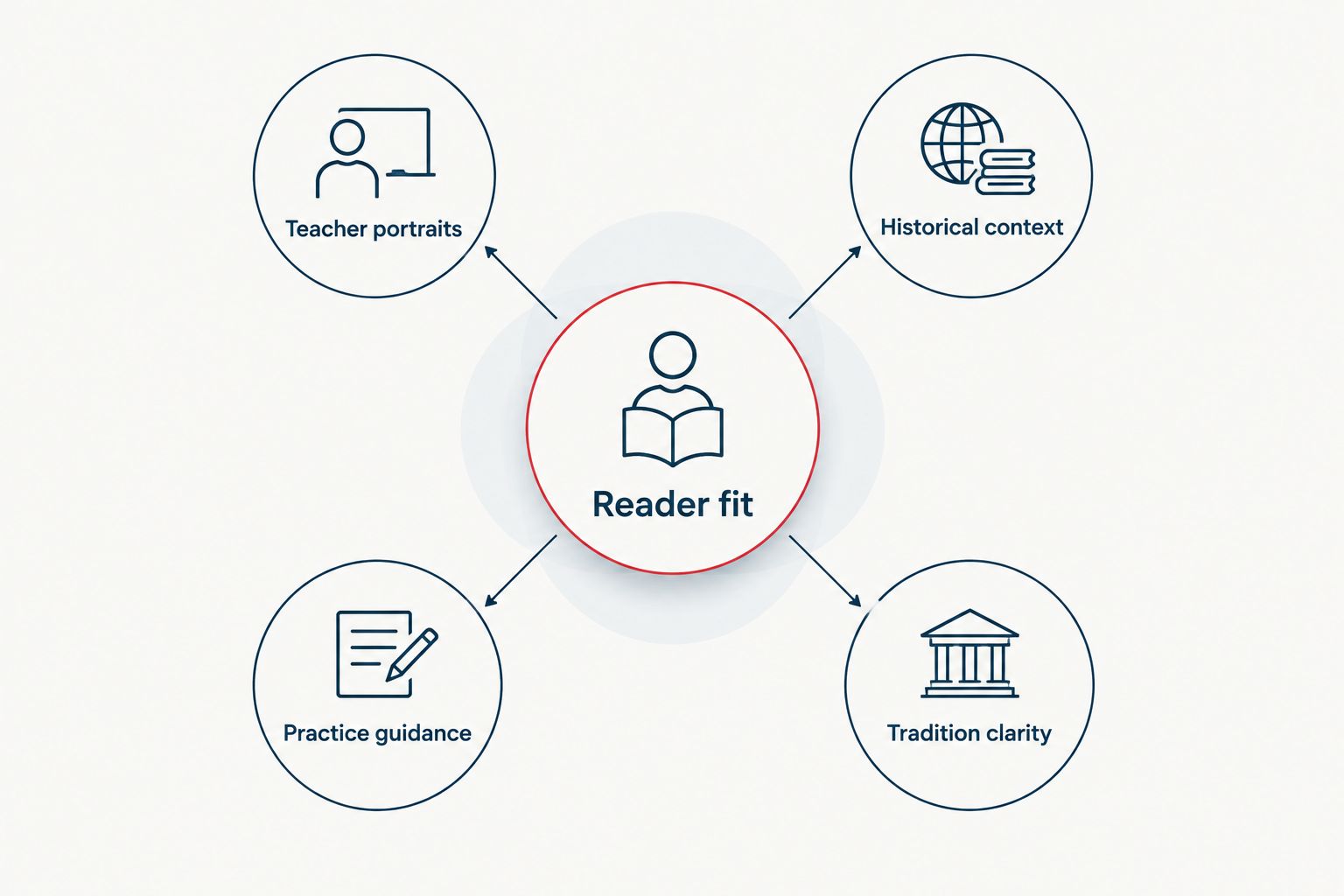
These criteria distinguish a useful starting point from a book that belongs later in a reading sequence:
- Teacher portraits: Does the book show identifiable women’s lives, training, and teaching rather than presenting an abstract account of empowerment?
- Historical context: Does it help readers understand the setting in which women practiced and taught?
- Practice guidance: Does it explain how teachings apply to experience, rather than stopping at admiration?
- Tradition clarity: Does it make its Buddhist setting apparent, without presenting one tradition as the whole of Buddhism?
- Reader fit: Is the book a biography, a collection of teaching stories, or an instructional work—and does that match the reader’s purpose?
A biography explains a teacher’s path; a practice book asks the reader to examine their own. Neither form replaces the other. For a first purchase in 2026, the decisive question is whether the reader wants to understand a life or work with a teaching.
The best books at a glance
| Book and author | Best for | Standout feature | Key limitation |
|---|---|---|---|
| Dakini Power — Michaela Haas | Contemporary teacher portraits | Profiles of 12 women in Tibetan Buddhism | Not a survey of every Buddhist tradition |
| Cave in the Snow — Vicki Mackenzie | One teacher’s life story | Biography of Tenzin Palmo and her retreat | One life cannot represent all female teachers |
| Women of Wisdom — Tsultrim Allione | Historical female practitioners | Six biographies linked with Buddhist teachings | Traditional narratives require contextual reading |
| The Hidden Lamp — Florence Caplow and Susan Moon, editors | Women’s teaching stories | 100 stories with contemporary commentary | Not a continuous biography or introductory textbook |
| When Things Fall Apart — Pema Chödrön | Practice during uncertainty | Teachings on meeting difficult experience | Not a history of female Buddhist teachers |
| Being Black — angel Kyodo williams | Zen, identity, and freedom | Buddhist practice discussed through Black experience | Not a collection of teacher biographies |
1. Dakini Power: best for contemporary teacher portraits
Dakini Power by journalist and author Michaela Haas profiles 12 women connected with the transmission of Tibetan Buddhism in the West. Its central value is breadth within a defined setting: readers encounter different lives rather than being asked to treat one teacher as representative of all women in Buddhism.
Dakini Power is the best starting point for readers seeking Michaela Haas’s portraits of contemporary female Buddhist teachers. The book belongs first in this list because its subject matches the query directly: women who practice, teach, and help shape Buddhist communities.
Dakini Power pros:
- Offers multiple teacher portraits in one volume.
- Connects teachings with the circumstances of individual lives.
- Keeps its focus on women within Tibetan Buddhism.
Dakini Power cons:
- Its Tibetan Buddhist focus does not cover the full range of Buddhist traditions.
- Portraits do not replace a structured meditation manual.
Best for: Readers seeking an accessible group portrait before choosing an individual teacher’s work.
Verdict: Buy for the clearest match to a 2026 search for contemporary female Buddhist teachers.
2. Cave in the Snow: best for one teacher’s life story
Vicki Mackenzie’s Cave in the Snow tells the story of Tenzin Palmo, the British-born Tibetan Buddhist nun known for spending 12 years in retreat in the Himalayas. Biography gives that commitment a human setting: the book follows a life rather than extracting a set of inspirational sayings.
Its strength is sustained attention. Where a collection moves between teachers, Mackenzie gives readers room to follow one woman’s choices, religious training, and encounters with barriers to women’s practice.
Cave in the Snow pros:
- Provides a continuous narrative centered on an identifiable teacher.
- Places intensive practice within a larger life story.
- Makes women’s opportunities in Buddhist institutions part of the subject.
Cave in the Snow cons:
- Tenzin Palmo’s unusually intensive path is not a template for ordinary daily practice.
- Readers seeking several traditions or teachers need another book alongside it.
Best for: Biography readers who want to understand one teacher in depth.
Verdict: Buy for a focused life story; skip it as the only source for understanding female Buddhist teachers as a group.
3. Women of Wisdom: best for historical female practitioners
Tsultrim Allione’s Women of Wisdom presents six biographies of female Buddhist practitioners, alongside material connecting their stories with practice. It changes the time frame of the reading list: women’s spiritual authority does not begin with contemporary publishing or Western Buddhist communities.
The book rewards attention to genre. Traditional religious biography is not the same as modern reported biography; accounts of realization and spiritual accomplishment need to be read within their religious setting, not flattened into ordinary documentary claims.
Women of Wisdom pros:
- Brings historical women into a reading list otherwise dominated by contemporary authors.
- Connects life stories with Buddhist practice.
- Offers a counterpoint to modern teacher profiles.
Women of Wisdom cons:
- Traditional accounts require more contextual interpretation than contemporary biography.
- Readers wanting a straightforward institutional history will need additional sources.
Best for: Readers interested in the historical roots of women’s Buddhist practice.
Verdict: Buy as a companion to contemporary portraits, not as a substitute for a general history of Buddhism.
4. The Hidden Lamp: best for women’s teaching stories
Edited by Florence Caplow and Susan Moon, The Hidden Lamp collects 100 stories of Buddhist women with commentary from contemporary female teachers. Its organizing unit is the teaching story, not a complete life.
That structure invites a slower reading pace. A short encounter can raise questions about authority, perception, or practice without supplying all the background that a biography would provide. The commentary creates a conversation between earlier stories and contemporary readers.
The Hidden Lamp pros:
- Gives women’s encounters and teachings a central place.
- Pairs stories with interpretations by contemporary female teachers.
- Suits readers who prefer to reflect on one passage at a time.
The Hidden Lamp cons:
- Short stories cannot provide the depth of a full biography.
- Readers seeking a linear introduction to Buddhist concepts need a different starting point.
Best for: Readers drawn to teaching stories, reflection, and discussion.
Verdict: Buy for contemplative reading; wait if the immediate need is a chronological life story.
5. When Things Fall Apart: best for practice during uncertainty
Pema Chödrön’s When Things Fall Apart addresses difficult experience through Buddhist teachings. It belongs here as a book by a female teacher, not as a book documenting the lives of female teachers.
That distinction is its advantage for the right reader. Someone who already knows whose teachings they want to explore can move from reading about authority to encountering instruction directly. The book’s emphasis is on relating to uncertainty and discomfort rather than constructing an idealized account of a teacher’s life.
When Things Fall Apart pros:
- Focuses on practice rather than biographical admiration.
- Uses accessible prose to discuss difficult emotional experience.
- Provides a direct encounter with Pema Chödrön’s teaching voice.
When Things Fall Apart cons:
- Does not explain the history of women’s roles across Buddhist traditions.
- Buddhist guidance is not a replacement for appropriate mental health care.
Best for: Readers seeking Buddhist practice guidance during uncertainty.
Verdict: Buy for instruction; skip it if the main goal is learning who female Buddhist teachers are.
6. Being Black: best for Zen, identity, and freedom
Being Black by angel Kyodo williams discusses Buddhist practice through Black experience. Its place in this guide is distinct: it brings questions of identity and freedom into contact with Zen teachings rather than offering another collection of teacher portraits.
The book broadens the questions a reading list can ask. Instead of treating spiritual practice as detached from social experience, it gives readers a way to consider how lived identity and Buddhist inquiry meet.
Being Black pros:
- Connects Buddhist practice with a specific social perspective.
- Adds a Zen-oriented voice to a list with several Tibetan Buddhist books.
- Centers questions that conventional biographical reading can leave aside.
Being Black cons:
- It is not a historical survey of female Buddhist teachers.
- Readers seeking a detailed teacher biography will need a companion volume.
Best for: Readers interested in Zen practice, Black experience, and freedom.
Verdict: Buy for this particular intersection; wait if the immediate priority is biographical background.
How these books are ranked
This 2026 ranking prioritizes fit with the search, then separates books by reading purpose. Dakini Power leads because it directly profiles female Buddhist teachers; Cave in the Snow follows for biographical depth. The remaining books fill distinct historical, teaching-story, practical, and social perspectives.
The order is an editorial reading recommendation, not a claim that one teacher or Buddhist tradition is better than another. The criteria favor clarity about what each book does—and what it leaves out.
Which book should an undecided reader choose?
Start with Dakini Power for contemporary female Buddhist teachers, then choose the next book by purpose. Michaela Haas’s collection provides the broadest direct entry among these selections without pretending to cover all of Buddhism.
For a focused 2026 reading path:
- Choose Cave in the Snow next for sustained biography.
- Choose Women of Wisdom next for historical practitioners.
- Choose The Hidden Lamp next for teaching stories and commentary.
- Choose When Things Fall Apart next for practice guidance.
- Choose Being Black next for Zen, identity, and freedom.
A reader already seeking practical instruction can reverse the order and begin with a teaching book. The useful sequence follows the reader’s question, not the prestige of a title.
FAQ
What’s the best book about female Buddhist teachers in 2026?
Dakini Power by Michaela Haas is the best starting point in this guide for contemporary female Buddhist teacher portraits. It profiles 12 women connected with Tibetan Buddhism, so it offers breadth without claiming to represent every Buddhist tradition.
Is Dakini Power better than Cave in the Snow?
Dakini Power is better for multiple teacher portraits; Cave in the Snow is better for one sustained biography. Vicki Mackenzie’s book follows Tenzin Palmo, while Dakini Power introduces a wider group of women.
Which book should a beginner read first?
A beginner seeking life stories should start with Dakini Power or Cave in the Snow. A beginner seeking practical guidance rather than biography should consider When Things Fall Apart.
Which book covers historical female Buddhist practitioners?
Women of Wisdom by Tsultrim Allione is the historical choice in this list. Its six biographies belong to a traditional religious context and should not be read as interchangeable with modern reported biographies.
Is The Hidden Lamp a collection of biographies?
The Hidden Lamp is a collection of teaching stories and commentary, not full-length biographies. Edited by Florence Caplow and Susan Moon, it contains 100 stories of Buddhist women.
Are all these books about Tibetan Buddhism?
No, this list includes books with different Buddhist settings. Being Black brings a Zen-oriented perspective, while Dakini Power and Cave in the Snow focus on women connected with Tibetan Buddhism.
Does When Things Fall Apart tell Pema Chödrön’s life story?
When Things Fall Apart is primarily a teaching book, not Pema Chödrön’s biography. Choose it for guidance on meeting difficult experience rather than for a detailed account of her life.
One last thing
Pair a portrait with a teaching text. Reading about a teacher’s dedication and reading that teacher’s instructions ask different things of the reader; keeping the distinction visible prevents admiration from being mistaken for understanding.
For this 2026 list, the most useful default is Dakini Power followed by a book whose purpose matches the reader’s next question. The reward is not a larger stack of books, but a clearer sense of whose voice is being heard and what kind of evidence supports the story.