
Best overall: The Wise Heart by Jack Kornfield. Best for self-criticism: Radical Acceptance by Tara Brach. Best for Buddhist foundations: What the Buddha Taught by Walpola Rahula. These Buddhist psychology books offer different entry points in 2026: practical reflection, traditional teachings, academic context, and scientific interpretation.
- The Wise Heart leads these Buddhist psychology books for readers seeking accessible explanations and contemplative practice.
- Radical Acceptance is the strongest starting point for readers interested in self-compassion and emotional acceptance.
- What the Buddha Taught explains Buddhist foundations without presenting Buddhism as a modern self-help technique.
- Buddhist Psychology by Geshe Tashi Tsering suits readers seeking a Tibetan Buddhist account of mind.
- Why Buddhism Is True offers a scientific argument, not a complete account of Buddhist traditions.
For readers of Michaela Haas interested in resilience, The Wise Heart is the best starting point for practical Buddhist psychology. Its strength is connecting Buddhist ideas with ordinary emotional life; its limitation is that accessible interpretation does not replace systematic study.
Why this matters
Buddhist psychology is not simply positive thinking with meditation added. Buddhist traditions examine suffering, perception, intention, attention, and the habits that shape experience. Modern authors connect those teachings with psychotherapy and scientific research, but the connections need careful reading.
A useful reading list separates three questions: What does a Buddhist tradition teach? How does an author apply that teaching? What does psychological research establish? A persuasive answer to one question does not automatically answer the others.
For a 2026 reading plan, the right book depends on the question being asked. Readers seeking emotional practices need a different starting point from readers studying Buddhist accounts of consciousness. None of these books should be treated as an individual diagnosis or treatment plan.
What makes the best Buddhist psychology books
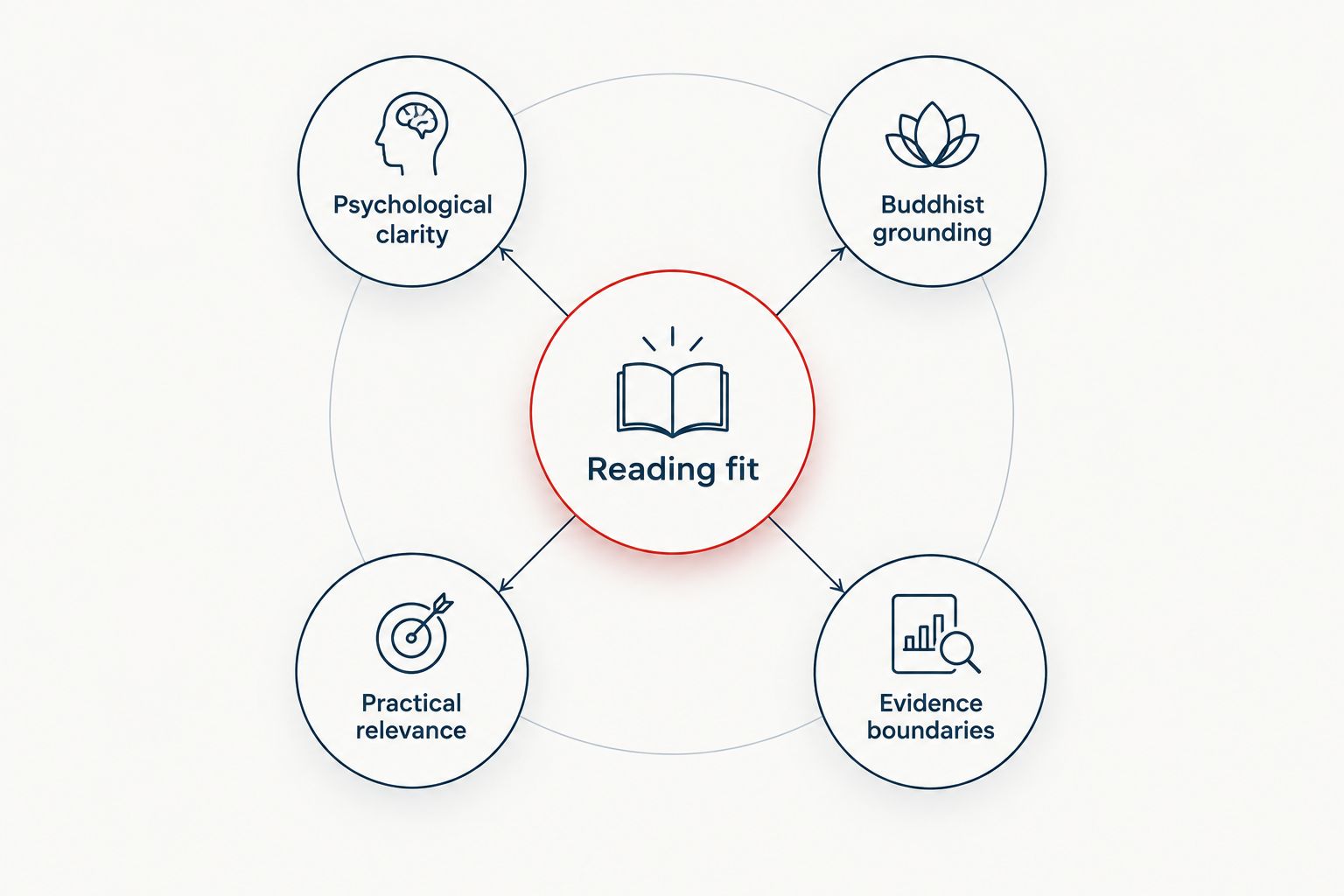
The ranking uses five criteria. Each matters because a book can be engaging while leaving its assumptions unexplained.
- Psychological clarity: The author explains mental habits and emotional experience rather than relying on spiritual slogans.
- Buddhist grounding: The book identifies the teachings or tradition behind its account of the mind.
- Practical relevance: Readers can connect the discussion to attention, relationships, distress, or everyday conduct.
- Evidence boundaries: Personal stories, religious teachings, philosophical arguments, and research findings remain distinguishable.
- Reading fit: The book's vocabulary and scope match its intended reader, whether beginner, practitioner, or student.
These criteria also prevent an unhelpful competition between unlike books. A doctrinal introduction does not fail because it lacks reflective exercises. A practice-oriented book does not become an academic reference simply because it discusses psychology.
Buddhist psychology books at a glance
The books below occupy different use-case slots. The order favors a general reader's first purchase, not a claim that one Buddhist tradition outranks another.
| Book and author | Best for | Standout feature | Key limitation |
|---|---|---|---|
| The Wise Heart — Jack Kornfield | Everyday emotional patterns | Buddhist psychology explained through teaching and stories | Not a systematic doctrinal textbook |
| Radical Acceptance — Tara Brach | Self-criticism and shame | Acceptance explored through psychological and contemplative perspectives | Narrower than a general survey of Buddhist psychology |
| What the Buddha Taught — Walpola Rahula | Foundational teachings | A direct introduction grounded in early Buddhist teachings | Not designed as a modern therapeutic workbook |
| Buddhist Psychology — Geshe Tashi Tsering | Tibetan accounts of mind | Structured discussion of consciousness and mental factors | Requires engagement with technical concepts |
| The Foundations of Buddhism — Rupert Gethin | Academic context | Buddhist thought placed within a broader religious framework | Less focused on personal exercises |
| Why Buddhism Is True — Robert Wright | Scientific interpretation | Evolutionary psychology brought into conversation with meditation | Its argument does not represent Buddhism in full |
1. The Wise Heart: best for everyday emotional patterns
Jack Kornfield's The Wise Heart presents Buddhist psychology through explanations, stories, and contemplative practices. Its central appeal is the connection between teachings about the mind and recognizable experiences such as fear, anger, attachment, and compassion.
The book works as a general starting point because it keeps psychological questions close to lived experience. Readers can begin with an emotional pattern and examine the Buddhist ideas associated with it, rather than first mastering a technical vocabulary.
The Wise Heart pros:
- Connects Buddhist teaching with everyday emotional concerns.
- Includes practices alongside explanation and narrative.
- Offers an accessible entry into compassion and mindful awareness.
The Wise Heart cons:
- Its broad interpretive approach is not a substitute for studying a particular tradition.
- Stories illustrate ideas but should not be read as controlled evidence of treatment effects.
Best for: Readers seeking a readable bridge between Buddhist teaching and emotional life.
For a general reader choosing one Buddhist psychology book in 2026, The Wise Heart is the default recommendation. Readers drawn to Michaela Haas's reporting on resilience can use it to explore contemplative approaches without treating those approaches as clinical prescriptions.
Verdict: Buy for practical orientation; choose a foundational text alongside it for doctrinal detail.
2. Radical Acceptance: best for self-criticism and shame
Tara Brach's Radical Acceptance addresses the experience of feeling deficient or unworthy. It brings Buddhist practice and a psychological perspective to the question of how people relate to painful emotions and judgments about themselves.
Its narrower focus is an advantage for readers whose main concern is harsh self-evaluation. Rather than surveying every major Buddhist account of mind, Radical Acceptance stays close to acceptance, awareness, and compassion.
Radical Acceptance pros:
- Gives self-criticism a clear place in the discussion.
- Connects contemplative practice with emotionally recognizable situations.
- Explores acceptance without reducing the subject to cheerful reassurance.
Radical Acceptance cons:
- Does not provide a broad history of Buddhist psychological thought.
- Its practices do not replace individualized mental health care.
Best for: Readers interested in self-compassion, shame, and their relationship with difficult emotions.
Acceptance should not be confused with approving harmful behavior. The useful reading question is whether the book helps distinguish acknowledging an experience from surrendering judgment or abandoning boundaries.
Verdict: Buy when self-criticism is the central question; skip as a stand-alone doctrinal introduction.
3. What the Buddha Taught: best for foundational teachings
Walpola Rahula's What the Buddha Taught introduces central Buddhist teachings with reference to early Buddhist texts. It gives readers a foundation for understanding ideas that modern psychology-oriented books often adapt or summarize.
The book explains the 4 noble truths and the noble eightfold path, whose 8 factors concern wisdom, ethical conduct, and mental cultivation. That context matters: Buddhist accounts of suffering are connected to ways of living, not just techniques for feeling calmer.
What the Buddha Taught pros:
- Explains foundational teachings directly.
- Grounds its presentation in early Buddhist textual sources.
- Helps readers recognize when modern authors are interpreting traditional concepts.
What the Buddha Taught cons:
- Does not function as a contemporary psychological workbook.
- Its focus does not cover every later Buddhist tradition or debate.
Best for: Beginners who want to understand the teachings behind contemporary Buddhist psychology.
In a 2026 reading sequence, What the Buddha Taught is a useful companion to a practice-focused book. It makes it easier to ask whether a modern author's account preserves a teaching's original context or redirects it toward a different purpose.
Verdict: Buy for foundations; pair with a practical book for everyday application.
4. Buddhist Psychology: best for Tibetan accounts of mind
Geshe Tashi Tsering's Buddhist Psychology is part of The Foundation of Buddhist Thought series. It introduces Buddhist accounts of consciousness and mental factors through a Tibetan Buddhist framework.
This is the stronger choice when the question is how a tradition describes the mind, rather than how to manage a particular emotion. It asks the reader to engage with categories and distinctions that do not map neatly onto contemporary clinical terminology.
Buddhist Psychology pros:
- Provides a clearly situated Tibetan Buddhist perspective.
- Gives mental processes more structured attention than a general inspirational book.
- Supports closer study of consciousness and mental factors.
Buddhist Psychology cons:
- Technical concepts demand slower reading.
- Traditional classifications should not be mistaken for modern diagnostic categories.
Best for: Readers ready to study Tibetan Buddhist explanations of mental experience.
A useful approach is to keep a glossary in the reader's own words. Before comparing a Buddhist term with a psychological term, establish what each means within its own framework.
Verdict: Buy for structured study; wait if a conversational introduction is still needed.
5. The Foundations of Buddhism: best for academic context
Rupert Gethin's The Foundations of Buddhism places Buddhist thought within its religious, historical, and practical setting. Its value for psychology-minded readers is precisely that it does not isolate the mind from the rest of Buddhism.
The book provides context for teachings such as impermanence, suffering, and not-self, often described as 3 characteristics of existence. Reading these ideas within a broader account prevents the assumption that Buddhism is simply an early version of modern psychotherapy.
The Foundations of Buddhism pros:
- Situates psychological ideas within Buddhist religion and practice.
- Gives readers a broader framework for comparing later interpretations.
- Suits study that extends beyond immediate self-help concerns.
The Foundations of Buddhism cons:
- Offers less immediate guidance for a specific emotional difficulty.
- Its academic presentation requires more sustained attention than a narrative introduction.
Best for: Students and curious readers who want context before drawing psychological conclusions.
Readers interested in the evidence-conscious approach associated with Michaela Haas can use this book as a check on simplified claims. The central question becomes not merely whether an idea sounds useful, but whether its source and meaning have been represented accurately.
Verdict: Buy for context; skip as the first choice for guided emotional practice.
6. Why Buddhism Is True: best for scientific interpretation
Robert Wright's Why Buddhism Is True examines Buddhist ideas and meditation through evolutionary psychology. Its distinctive contribution is an argument about how human perceptions and desires can mislead people, and how contemplative practice relates to that problem.
The title makes a large claim, but the book's scope needs a narrower reading. It offers a particular interpretation of selected Buddhist ideas, not proof of every Buddhist teaching, cosmological claim, or religious practice.
Why Buddhism Is True pros:
- Makes a direct connection between evolutionary psychology and contemplative questions.
- Gives scientifically curious readers an accessible entry point.
- Encourages examination of feelings and perceptions rather than automatic trust in them.
Why Buddhism Is True cons:
- Its scientific framing does not encompass Buddhism's full religious scope.
- An explanatory argument is not the same as establishing an individual clinical benefit.
Best for: Readers who want to examine a scientific case for selected Buddhist insights.
Read Robert Wright alongside Walpola Rahula or Rupert Gethin to keep interpretation and tradition distinct. Agreement between authors can be illuminating; disagreement is a reason to investigate, not to force the accounts into one vocabulary.
Verdict: Buy for the argument; skip as the sole introduction to Buddhism.
How the books are ranked
This 2026 ranking prioritizes reading fit, psychological clarity, Buddhist grounding, practical relevance, and evidence boundaries. It compares the books' subjects and approaches; it does not rank them by clinical outcomes or claim that reading one produces measurable recovery.
The Wise Heart comes first because it fits the broadest practical entry point. The remaining books answer more specific questions: self-criticism, foundational teachings, Tibetan mental classifications, academic context, and scientific interpretation.
Which Buddhist psychology book should be chosen?
Choose The Wise Heart when the goal is an accessible introduction connected to everyday emotions. Choose Radical Acceptance instead when self-criticism is the main concern, or What the Buddha Taught when understanding Buddhist teachings comes first.
For a deeper reading plan, combine contrasting approaches rather than several books making similar promises. A practical book plus a foundational text creates room to examine both application and context. Technical or scientific reading can follow once that distinction is clear.
FAQ
What's the best Buddhist psychology book for beginners in 2026?
The Wise Heart by Jack Kornfield is the best general starting point for practical Buddhist psychology. What the Buddha Taught by Walpola Rahula is the better first choice when foundational teachings matter more than everyday application.
Is Radical Acceptance better than The Wise Heart?
Radical Acceptance is better suited to readers focused on self-criticism and shame, while The Wise Heart offers a broader practical introduction. The choice depends on the reader's main question, not on one book being universally better.
Which book explains Tibetan Buddhist psychology?
Buddhist Psychology by Geshe Tashi Tsering introduces accounts of consciousness and mental factors through a Tibetan Buddhist framework. It suits readers prepared to work with technical concepts rather than expecting a conversational self-help book.
Is Why Buddhism Is True a complete introduction to Buddhism?
Why Buddhism Is True is not a complete introduction to Buddhism. Robert Wright develops a scientific interpretation of selected ideas, so a foundational or academic text provides useful religious and historical context.
Can Buddhist psychology books replace therapy?
Buddhist psychology books do not replace individualized mental health care. They offer teachings, interpretations, and practices, but they do not establish a reader's diagnosis or appropriate treatment.
Do readers need to be Buddhist to read these books?
Readers do not need to identify as Buddhist to study these books. Careful reading still requires attention to the traditions behind the teachings rather than treating every concept as a generic wellness technique.
Which Buddhist psychology books work well together?
The Wise Heart and What the Buddha Taught offer complementary practical and foundational perspectives. The Foundations of Buddhism adds broader context, while Why Buddhism Is True supplies a distinct scientific argument.
One last thing
For the 2026 reading list, keep a simple margin-note distinction: teaching, interpretation, or evidence. A passage can be valuable without belonging to all three categories. Identifying which kind of claim an author makes is a better reading habit than accepting or rejecting a whole book at once.